
#2263. GESP 202406 C++ 六级
-
ID: 2263
客观题
尝试: 0
已通过: 0
难度: 9
上传者:
 zhangyiming
标签>
zhangyiming
标签> GESP 202406 C++ 六级
1、面向对象的编程思想主要包括( )原则。
{{ select(1) }}
- 贪心、动态规划、回溯
- 并发、并行、异步
- 递归、循环、分治
- 封装、继承、多态
2、运行下列代码,屏幕上输出( )。
#include <iostream>
using namespace std;
class my_class {
	public:
		static int count;
		my_class() {
			count++;
		}
		~my_class() {
			count--;
		}
		static void print_count() {
			cout << count << " ";
		}
};
int my_class::count = 0;
int main() {
	my_class obj1;
	my_class::print_count();
	my_class obj2;
	obj2.print_count();
	my_class obj3;
	obj3.print_count();
	return 0;
}
{{ select(2) }}
- 1 1 1
- 1 2 3
- 1 1 2
- 1 2 2
3、运行下列代码,屏幕上输出( )。
#include <iostream>
using namespace std;

class shape {
protected:
    int width, height;
public:
    shape(int a = 0, int b = 0) {
        width = a;
        height = b;
    }
    virtual int area() {
        cout << "parent class area: " << endl;
        return 0;
    }
};

class rectangle: public shape {
public:
    rectangle(int a = 0, int b = 0) : shape(a, b) { }

    int area() {
        cout << "rectangle area: ";
        return (width * height);
    }
};

class triangle: public shape {
public:
    triangle(int a = 0, int b = 0) : shape(a, b) { }

    int area() {
        cout << "triangle area: ";
        return (width * height / 2);
    }
};

int main() {
    shape *pshape;
    rectangle rec(10, 7);
    triangle tri(10, 5);

    pshape = &rec;
    pshape->area();

    pshape = &tri;
    pshape->area();
    return 0;
}
{{ select(3) }}
- rectangle area: triangle area:
- parent class area: parent class area:
- 运行时报错
- 编译时报错
4、向一个栈顶为 hs 的链式栈中插入一个指针为 s 的结点时,应执行( )。
{{ select(4) }}
- hs->next = s;
- s->next = hs; hs = s;
- s->next = hs->next; hs->next = s;
- s->next = hs; hs = hs->next;
5、在栈数据结构中,元素的添加和删除是按照什么原则进行的?( )
{{ select(5) }}
- 先先进出
- 先进后出
- 最小值先出
- 随机顺序
6、要实现将一个输入的十进制正整数转化为二进制表示,下面横线上应填入的代码为( )。
#include <iostream>
using namespace std;

stack<int> ten2bin(int n) {
    stack<int> st;
    int r, m;

    r = n % 2;
    m = n / 2;
    st.push(r);

    while (m != 1) {
        r = m % 2;
        st.push(r);
        m = m / 2;
    }
    st.push(m);
    return st;
}

int main() {
    int n;
    cin >> n;
    stack<int> bin;
    bin = ten2bin(n);
    while (!bin.empty()) {
        __________________ // 在此处填入代码
    }
    return 0;
}
{{ select(6) }}
- cout << bin.top(); bin.pop();
- bin.pop(); cout << bin.top();
- cout << bin.back(); bin.pop();
- cout << bin.front(); bin.pop();
7、下面定义了一个循环队列的类,请补全判断队列是否满的函数,横向上应填写( )。
#include <iostream>

using namespace std;

class circular_queue {
private:
    int *arr; // 数组用于存储队列元素
    int capacity; // 队列容量
    int front; // 队头指针
    int rear; // 队尾指针

public:
    circular_queue(int size) {
        capacity = size + 1; // 为了避免队列满时与队列空时指针相等的情况,多预留一个空间
        arr = new int[capacity];
        front = 0;
        rear = 0;
    }

    ~circular_queue() {
        delete[] arr;
    }

    bool is_empty() {
        return front == rear;
    }

    bool is_full() {
        // 在此处填入代码
    }

    void en_queue(int data) {
        if (is_full()) {
            cout << "队列已满,无法入队!" << endl;
            return -1;
        }
        arr[rear] = data;
        rear = (rear + 1) % capacity;
        return 1;
    }

    int de_queue() {
        if (is_empty()) {
            cout << "队列为空,无法出队!" << endl;
            return -1; // 出队失败,返回一个特殊值
        }
        int data = arr[front];
        front = (front + 1) % capacity;
        return data;
    }
};

{{ select(7) }}
- `return (rear + 1) % capacity == front;`
- `return rear % capacity == front;`
- `return rear == front;`
- `return (rear + 1) == front;`

8、对“classmycls”使用哈夫曼(Huffman)编码,最少需要( )比特。

{{ select(8) }}
- $10$
- $20$
- $25$
- $30$

9、二叉树的( )第一个访问的节点是根节点。

{{ select(9) }}
- 先序遍历
- 中序遍历
- 后序遍历
- 以上都是

10、一棵 $5$ 层的满二叉树中节点数为( )。

{{ select(10) }}
- $31$
- $32$
- $33$
- $16$

11、在求解最优化问题时,动态规划常常涉及到两个重要性质,即最优子结构和( )。

{{ select(11) }}
- 重叠子问题
- 分治法
- 贪心策略
- 回溯算法

12、青蛙每次能跳 $1$ 或 $2$ 步,下面代码计算青蛙跳到第 $n$ 步台阶有多少种不同跳法。则下列说法,错误的是( )。
```cpp
int jump_recur(int n) {
    if (n == 1) return 1;
    if (n == 2) return 2;
    return jump_recur(n - 1) + jump_recur(n - 2);
}

int jump_dp(int n) {
    vector<int> dp(n + 1); // 创建一个动态规划数组,用于保存已计算的值
    // 初始化前两个数
    dp[1] = 1;
    dp[2] = 2;
    // 从第三个数开始计算斐波那契数列
    for (int i = 3; i <= n; ++i) {
        dp[i] = dp[i - 1] + dp[i - 2];
    }
    return dp[n];
}
{{ select(12) }}
- 函数
jump_recur()采用递归方式。 - 函数
jump_dp()采用动态规划方法。 - 当 较大时,函数
jump_recur()存在大量重复计算,执行效率低。 - 函数
jump_recur()代码量小,执行效率高。
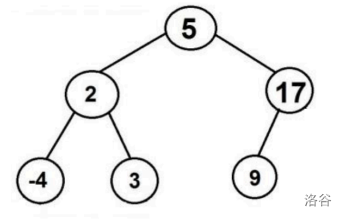
13、阅读以下二叉树的广度优先搜索代码:
#include <iostream>
#include <queue>

using namespace std;

// 二叉树节点的定义
struct TreeNode {
    int val;
    TreeNode* left;
    TreeNode* right;
    TreeNode(int x) : val(x), left(nullptr), right(nullptr) {}
};

// 宽度优先搜索(BFS)迭代实现
TreeNode* bfs(TreeNode* root, int a) {
    if (root == nullptr) return nullptr;

    queue<TreeNode*> q;
    q.push(root);

    while (!q.empty()) {
        TreeNode* node = q.front();
        q.pop();

        if (node->val == a)
            return node;

        cout << node->val << " "; // 先访问当前节点

        if (node->left) q.push(node->left); // 将左子节点入队
        if (node->right) q.push(node->right); // 将右子节点入队
    }
    return nullptr;
}
使用以上算法,在以下这棵树搜索数值 时,可能的输出是( )。
{{ select(13) }}
- 5 2 -4 3 17 9
- -4 2 3 5 9 17
- 5 2 17 -4 3 9
- 以上都不对
14、同上题中的二叉树,阅读以下二叉树的深度优先搜索代码:
#include <iostream>
#include <stack>

using namespace std;

// 非递归深度优先搜索(DFS)
TreeNode* dfs(TreeNode* root, int a) {
    if (root == nullptr) return nullptr;

    stack<TreeNode*> stk;
    stk.push(root);

    while (!stk.empty()) {
        TreeNode* node = stk.top();
        stk.pop();
        if (node->val == a)
            return node;

        cout << node->val << " "; // 访问当前节点

        if (node->right) stk.push(node->right); // 先压入右子节点
        if (node->left) stk.push(node->left); // 再压入左子节点
    }
    return nullptr;
}
使用以上算法,在二叉树搜索数值 时,可能的输出是( )。
{{ select(14) }}
- 5 2 -4 3 17 9
- -4 2 3 5 9 17
- 5 2 17 -4 3 9
- 以上都不对
15、在上题的树中搜索数值 时,采用深度优先搜索一共比较的节点数为( )。
{{ select(15) }}
16、哈夫曼编码本质上是一种贪心策略。
{{ select(16) }}
- 正确
- 错误
17、创建一个对象时,会自动调用该对象所属类的构造函数。如果没有定义构造函数,编译器会自动生成一个默认的构造函数。
{{ select(17) }}
- 正确
- 错误
18、定义一个类时,必须手动定义一个析构函数,用于释放对象所占用的资源。
{{ select(18) }}
- 正确
- 错误
19、C++ 中类内部可以嵌套定义类。
{{ select(19) }}
- 正确
- 错误
20、 是一组格雷码。
{{ select(20) }}
- 正确
- 错误
21、 个节点的双向循环链表,在其中查找某个节点的平均时间复杂度是 。
{{ select(21) }}
- 正确
- 错误
22、完全二叉树可以用数组存储数据。
{{ select(22) }}
- 正确
- 错误
23、在 C++ 中,静态成员函数只能访问静态成员变量。
{{ select(23) }}
- 正确
- 错误
24、在深度优先搜索中,通常使用队列来辅助实现。
{{ select(24) }}
- 正确
- 错误
25、对 0-1 背包问题,贪心算法一定能获得最优解。
{{ select(25) }}
- 正确
- 错误
 苏公网安备 32118302000875号